Logitech K620 First Look: Unboxing and Impressions
The Logitech K620 arrives as a practical, understated wireless keyboard aimed at people who prioritize a compact footprint and quiet, everyday typing. This first-look review walks through the unboxing experience, the keyboard’s design and build, how it feels to type on, setup and connectivity, real-world use cases that match its strengths, and what buyers should consider before purchasing. The goal is to give a clear, useful picture of what to expect from the K620 during the first days of ownership so readers can decide whether it fits their needs.
Introduction
Logitech has a long history of producing reliable keyboards for home, office and portable use. The K620 positions itself in the lineup as a solution for those who want a low-profile wireless option with a sensible layout and minimal fuss. In a market crowded with mechanical switches, multi-device Bluetooth hubs, and RGB lighting, the K620 takes a quieter, more conservative route focused on productivity and comfort.
Unboxing and First Impressions
Out of the box, the K620 presents a no-nonsense package. The keyboard itself is the centerpiece, surrounded by basic documentation — a quick-start guide, warranty information, and sometimes a small leaflet for Logitech’s software. Many units include the wireless USB receiver tucked into a compartment, and a pair of batteries preinstalled for immediate use. The packaging is compact and protective: nothing flashy, but durable enough to protect the keyboard in transit.
Initial handling reveals a lightweight but solid-feeling shell. The K620 does not aim to impress with premium materials; instead it prioritizes a matte plastic finish that resists fingerprints and keeps the overall weight low for those who occasionally slip it into a bag. The profile is shallow, reflecting the low-profile keycaps and a slight incline that promotes a relaxed wrist position.
Design and Build Quality
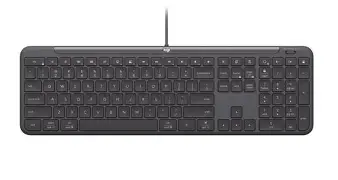
The K620’s design language is restrained. It uses a compact full-width layout that includes a standard set of keys and a dedicated numeric keypad — useful for spreadsheets and data entry — while keeping overall depth and width modest. The keyboard’s stabilizers and keycaps are engineered to avoid wobble and to provide a consistent feel across the deck. The underside usually features modest rubber feet and a simple tilt mechanism to adjust typing angle by a degree or two.
Build quality leans toward practicality rather than premium aesthetics. The chassis is plastic but well-assembled, with no significant creaks during normal use. For users who expect metal plates or high-rigidity frames, this won’t be a flagship feel, but for everyday office use the construction is wholly adequate.
Keys and Typing Experience
Typing on the K620 emphasizes low profile, short travel, and a quiet rebound. The keys are tuned to deliver a comfortable, office-friendly experience without the clickiness of mechanical switches. The tactile feedback is moderate — not mushy, but not sharp — and suits long typing sessions where fatigue is a concern.
Keycaps are sculpted in a gentle curve to guide fingers toward home-row accuracy. The layout follows standard spacing and placement, so there is no relearning required for common shortcuts. The numeric keypad is responsive and helpful for users who work with numbers regularly, and the arrow cluster is intact and easy to reach.
From a noise standpoint, the K620 is intentionally quiet. It complements shared workspaces, open offices, or late-night typing at home without drawing attention. Gamers who rely on audible switch feedback or ultra-fast actuation may prefer mechanical alternatives, but for typists and office users the K620’s subdued soundscape is an asset.
Looking for the best Laptops & Computers deals on Amazon?
View Offers →Connectivity and Setup
Setup is straightforward. The keyboard pairs quickly with the included wireless receiver (or via Bluetooth if the specific variant supports it). Logitech’s pairing process has matured over generations: plug in the receiver, switch on the keyboard, and the system recognizes it almost immediately on Windows and most modern operating systems.
Compatibility-wise, the K620 plays well with Windows and macOS at a basic level. Modifier keys and media shortcuts generally map correctly, though power users who want deep customizations may need to install Logitech’s companion software for key remapping and function management. Linux users report varying levels of compatibility depending on distribution and kernel versions; basic typing and standard shortcut keys typically work without extra drivers.
Battery Life and Power Management
One of the considerations buyers typically care about is battery life. The K620 is designed to be efficient: with low-power wireless electronics and an absence of power-hungry features like backlighting, it tends to offer extended time between battery changes. Actual battery life will depend on daily usage patterns — intensive use shortens runtime, while occasional use can stretch batteries well beyond the average.
Power management features include an on/off switch and an auto-sleep mode after periods of inactivity. For most office users, this translates to weeks or months of operation on a single set of batteries. Those who prioritize maximum longevity should keep an eye on which type of batteries are used (alkaline vs rechargeable) and consider using rechargeable cells if a stable long-term cost is desired.
Software and Customization
For users who want to customize function keys, reassign media controls, or fine-tune behavior, Logitech provides companion software that unlocks extra features. The software makes it possible to remap keys and configure system-level shortcuts. However, the K620’s hardware is intentionally simple; the lack of onboard RGB and macro layers means the customization surface is more modest compared with enthusiast keyboards.
Those who value plug-and-play simplicity can skip the software entirely and still enjoy a full-featured typing experience. The balance between simplicity and optional customization is one of the K620’s strengths.
Real-World Use Cases
The K620 suits several real-world scenarios well:
- Office Typing and Data Entry: The inclusion of a numeric keypad and predictable layout make the K620 a solid choice for spreadsheet-heavy work and clerical tasks.
- Home Office: Quiet operation and compact footprint are ideal for shared home spaces or small desks.
- Portable Work Setup: While not ultra-compact, the lightweight build makes it easy to carry between rooms or slip into a laptop bag for occasional remote work.
- Classroom or Meeting Rooms: The keyboard’s unobtrusive sound profile and simple setup are suited to collaborative environments where distractions should be minimized.
Conversely, this is not the keyboard to buy if backlighting, mechanical switch feel, or advanced macro programming are top priorities. It intentionally trades those enthusiast features for quiet, everyday usability.
Pros & Cons
- Pros
- Compact full-size layout with dedicated numeric keypad, useful for productivity tasks
- Quiet, low-profile keys that are comfortable for long typing sessions
- Straightforward setup and broad cross-platform compatibility for basic use
- Lightweight and portable without feeling flimsy
- Long battery life in typical office scenarios due to power-efficient design
- Cons
- Limited customization compared with higher-end Logitech models and mechanical keyboards
- No backlighting, which limits use in dim environments
- Plastic build and conservative aesthetics may not appeal to users seeking premium materials
- Not targeted at gamers or heavy macro users
Comparison Table
| Feature | Logitech K620 (First Look) | Typical Bluetooth Compact Keyboard | Entry Mechanical Keyboard |
|---|---|---|---|
| Layout | Full-width with numeric keypad | Often tenkeyless or smaller | Varies: TKL, full or compact |
| Key Type | Low-profile, quiet membrane-style | Low-profile scissor or membrane | Mechanical switches (tactile/clicky/linear) |
| Connectivity | Wireless (USB receiver or variant Bluetooth) | Bluetooth (multi-device) | Wired or wireless depending on model |
| Battery | Long-lasting, power-efficient | Varies; generally long with low-power designs | Often rechargeable or replaceable batteries |
| Customization | Basic through companion software | Limited | High (programmable keys, macros) |
| Ideal For | Office productivity, home office | Portability, multi-device users | Gamers, typists, power users |
Buying Guide: Who Should Consider the K620?
When deciding whether the K620 is a good fit, buyers should weigh their primary activities and what they value most in a keyboard:
Shop the latest Laptops & Computers picks on Amazon.
View Offers →1. Primary Use: Productivity over Play
If the bulk of the work involves typing, managing spreadsheets, writing reports, or attending video calls, the K620’s comfortable low-profile keys and numeric keypad make it a practical choice. Its quiet operation suits shared environments where audible switch feedback could be distracting.
2. Desk Space and Portability
For users with limited desk area or those who carry a keyboard between home and a secondary workspace, the K620 balances a full set of keys with a compact footprint. It is not the smallest possible keyboard, but it keeps essential keys without the bulk of larger, gaming-focused boards.
3. Customization Needs
Buyers who want deep customization — per-key RGB, complex macros, or mechanical switch swaps — should look elsewhere. The K620 offers modest software-driven remapping for common workflows, but it does not compete with enthusiast-grade models in this realm.
4. Noise and Office Etiquette
In open-plan offices, shared home offices, or quiet study spaces, minimizing noise is often a priority. The K620’s subdued acoustics make it an attractive option for people who want to be considerate of nearby coworkers or family members.
5. Budget and Value
The K620 targets buyers who want reliable daily performance without spending on premium materials or gaming features. It is positioned as a practical, cost-conscious choice for users who prefer function and comfort over flash.
Practical Tips Before Buying
- Test the feel if possible: Low-profile membrane keyboards vary, so try a demo to ensure the tactile feedback feels right for long sessions.
- Check connectivity needs: Confirm whether the model includes a USB receiver or Bluetooth, and whether that matches the devices it will pair with.
- Consider rechargeable batteries: If long-term cost or environmental impact matters, plan for rechargeable cells for the best value.
- Confirm platform support: Make sure the keyboard maps modifier keys correctly on your primary OS and that any companion software is available for your platform if you need remapping.
- Look at ergonomics: If wrist comfort is a priority, pair the keyboard with a wrist rest or consider a slight desk tilt to keep wrists neutral.
Conclusion
The Logitech K620 makes a clear, focused proposition: a quiet, compact full-width keyboard tuned for everyday productivity. In this first look, it strikes a balance between functionality and simplicity, offering a sensible layout with a numeric keypad, comfortable low-profile keys, and straightforward wireless setup. It is well suited to office workers, students, and anyone who values a discreet typing experience over gaming bells and whistles.
It is not a niche device for mechanical-keyboard enthusiasts or macro-heavy workflows, nor does it aim to be. Instead, the K620 is a practical workhorse that blends portability, quiet operation, and usability into a neat package. For buyers who need a reliable, unobtrusive keyboard for everyday tasks, the K620 is worth considering; those who need advanced customization, backlighting, or a premium build should compare it to other models in Logitech’s portfolio or the broader market.